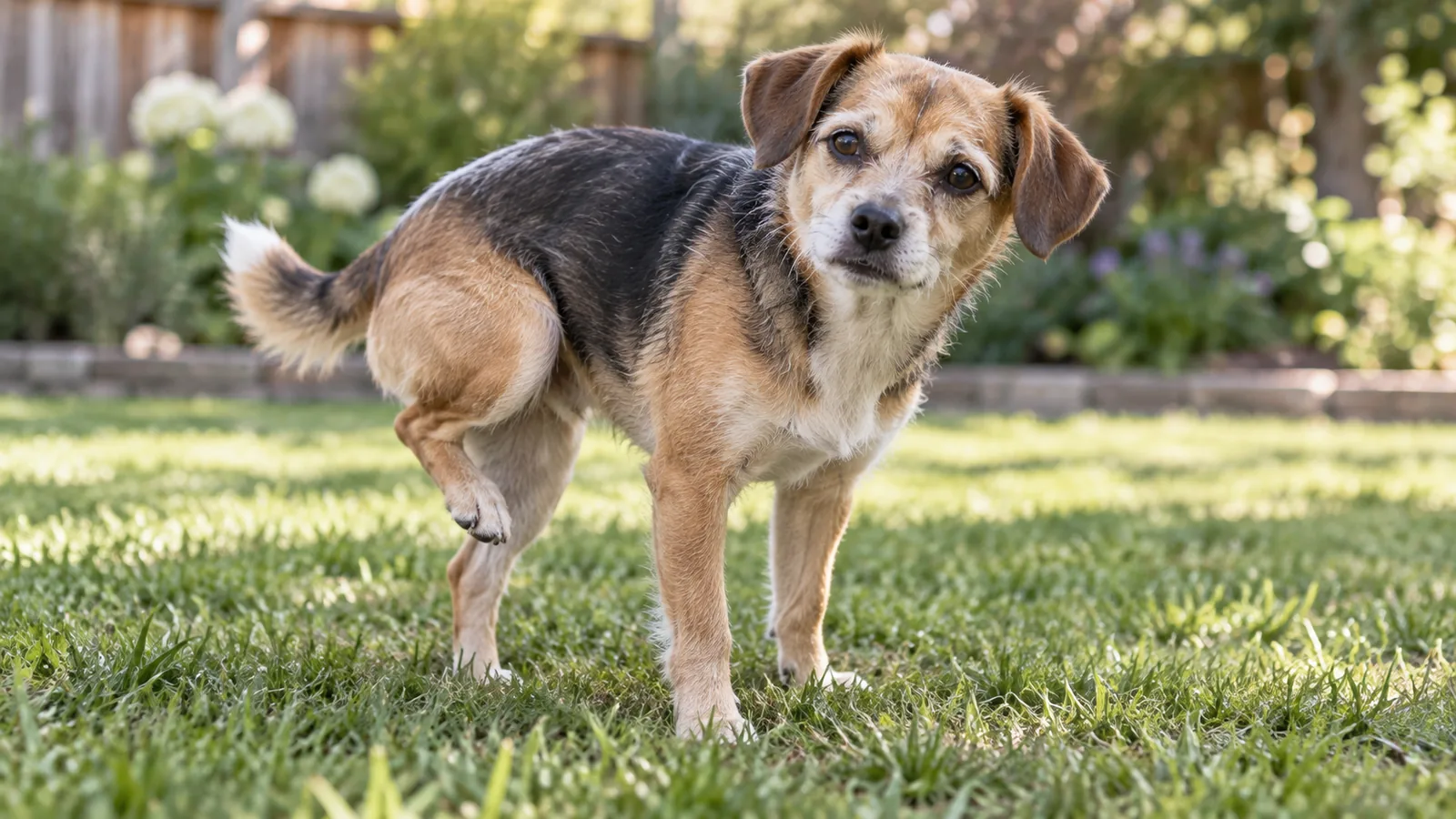
Your dog is trotting across the yard when a back leg suddenly pops up. She hops two or three times on three legs, gives the paw a little shake, and takes off running again like nothing happened. You stand there wondering if you imagined it. If this sounds familiar, what you likely saw is patellar luxation: the kneecap briefly slipping out of the groove it normally sits in, catching the joint for a moment, then popping back into place on its own. It is one of the most common orthopedic conditions in dogs, and while it can occur in cats too, small and toy breeds carry the largest share of cases. Whether that skip needs watching or surgical correction depends on how far the kneecap slips, how often it happens, and how your dog is doing day to day.
At Peak Pet Urgent Care, we see dogs for exactly this kind of moment, a leg that looked wrong for a few seconds and then didn't. A patellar luxation exam is quick, needs no sedation, and gives you a clear answer about grade and next steps the same day. When surgical repair is the right call, we perform patellar luxation surgery here rather than sending you elsewhere, so your dog's care stays in one place from evaluation through recovery. If you have noticed a skip or a hop you cannot quite explain, reach out to our team and we will help you figure out what you are looking at.
What to Know About Patellar Luxation in Dogs
- Patellar luxation is graded 1 through 4, and higher grades along with worsening symptoms usually point toward surgery.
- Even a kneecap that pops right back into place is quietly wearing down cartilage between skips.
- Weight control, joint supplements, and rehabilitation support every affected dog, whether or not surgery is part of the plan.
- Dogs with patellar luxation face a meaningfully higher risk of cruciate ligament injury down the road.
What Actually Happens When a Dog's Kneecap Slips?
The patella, or kneecap, normally sits in a groove at the end of the femur and glides smoothly as the leg bends and straightens. In patellar luxation, it slips out of that groove, usually toward the inside in small dogs or occasionally toward the outside in larger ones, briefly catching the joint before sliding back.
The quadriceps attaches to the top of the patella and the patellar tendon runs from there to the tibia, so a properly seated kneecap transfers force smoothly from thigh to lower leg with every stride. Medial luxation is the most common direction, mostly in small breeds; lateral luxation is less common and tends to affect large and giant breeds. Most dogs have some combination of a shallow groove, femur and tibia misalignment, and uneven soft tissue pull, which is why patellar luxation is considered multifactorial rather than a single structural defect.
Which Dogs Are Most Likely to Develop Patellar Luxation?
Patellar luxation has a strong hereditary component, and small and toy breeds, including Chihuahuas, Pomeranians, Yorkshire Terriers, Boston Terriers, Toy Poodles, Maltese, and Bichons, make up the largest share of cases by far, almost always with medial luxation.
- Small and toy breeds: the largest affected group, almost always with medial luxation.
- Large and giant breeds: less commonly affected, but lateral luxation is more typical when they are.
- Mixed-breed dogs: conformation matters more than a label on paper, and a small-breed branch in the family tree is enough to inherit the structural setup.
Because the condition runs in families, responsible breeders screen for it, and OFA patellar luxation screening gives them an objective grade to work from.
What Are the Signs of Patellar Luxation in Dogs?
The classic sign is a brief skip or hop on a back leg that resolves within seconds, but patellar luxation can look like much more, from bunny-hopping to a general slowdown on walks, especially when both back legs are affected.
- The classic intermittent skip or hop on a back leg
- Bunny-hopping, where both back legs move together instead of alternating
- Reluctance to jump onto the couch, bed, or into the car
- Hesitation or slowing down on stairs
- An occasional yelp or a leg held up briefly
- Less stamina than usual on walks or during play
How dramatic the symptoms look does not always line up with the grade, and a fair number of cases turn up during a routine wellness exam when a family had not noticed anything at home.
What Should You Do When You Notice the Skip?
If you catch your dog skipping on a back leg, the most useful thing you can do is film it, since the skip is intermittent and a few seconds of video tells us more than any description.
- Film the episode the next time it happens, since it rarely happens on command in an exam room.
- Note the pattern. Which leg, how often, and whether she seems sore afterward.
- Schedule an orthopedic evaluation. A patellar luxation exam does not require sedation, and you can come in for urgent pet care in Reno without waiting weeks for an opening.
- Try not to panic. Plenty of dogs with patellar luxation never need surgery, and catching it early gives you the most options.
How Is Patellar Luxation Diagnosed and Graded?
Diagnosing patellar luxation starts with a hands-on exam, not imaging. We flex and extend the knee to feel whether the kneecap can be pushed out of its groove, how much pressure that takes, and whether it slides back on its own, with X-rays adding detail once luxation is confirmed.
The exam tells us whether the patella displaces easily and whether limb alignment shows longstanding bony changes. X-rays document baseline joint status and rule out conditions that sometimes travel alongside patellar luxation, particularly cruciate ligament disease and hip dysplasia, before we assign a grade from 1 to 4.
| Grade | What's Happening |
| Grade 1 | Patella can be pushed out of place with manual pressure but returns immediately when released; usually found incidentally, with no symptoms at home |
| Grade 2 | Kneecap luxates occasionally during normal activity and returns on its own or with movement; the intermittent skip families notice, and the most common grade |
| Grade 3 | Luxated more often than not, can be reduced manually but pops back out with any motion; gait looks abnormal most of the time |
| Grade 4 | Constantly luxated and cannot be manually reduced; comes with significant bony deformity and visibly abnormal limb conformation |
Grade matters, but it is not the whole story: age, weight, activity level, symptom burden, and overall health all factor into whether we recommend watching, managing, or repairing surgically.
What Are the Treatment Options for Patellar Luxation?
There is no single right answer for every dog with patellar luxation. The right plan depends on grade, how bothered your dog actually seems, age, and what you are hoping for, and it can range from monitoring and weight control to surgical repair.
When Is Conservative Management the Right Call?
Conservative management fits low-grade luxation with minimal symptoms, young growing dogs being watched before surgery, dogs who are not good surgical candidates, and families who choose a non-surgical path after weighing the options with us.
- Activity modification: limiting jumping, hard sprinting, and slick floors that make the knee more likely to give.
- Weight control: one of the most impactful things you can do, since every extra pound adds stress to a joint already at a disadvantage.
- Physical rehabilitation: targeted exercises that build the quadriceps and supporting muscles.
- Pain management: medication when your dog is showing real discomfort, something we can talk through at that same visit.
Watching it only works with real rechecks and willingness to revisit the plan if things change; the right call at three years old is not necessarily the right call at seven.
Do Knee Braces Help With Patellar Luxation?
Knee braces have a narrow but real role: low-grade luxation in dogs who are not surgical candidates, short-term stabilization, or bridging the gap while you decide on surgery. What they cannot do is fix the underlying bony deformity, and an ill-fitted brace can worsen alignment rather than help it. We are happy to talk through where your dog fits.
How Does Rehabilitation Support Recovery?
Physical rehabilitation is not just something dogs do after surgery; it is part of conservative management too, building the muscles that support the kneecap whether or not surgery happens. A typical program includes therapeutic exercises for the quadriceps, range-of-motion work, and underwater treadmill sessions for low-impact strengthening. Dogs who start rehabilitation for patellar luxation before surgery, sometimes called prehab, and continue it after tend to come out stronger on that leg than dogs who skip it.
When Is Surgery the Right Call, and What Does It Involve?
Surgery is generally the right call for Grade 3 and 4 luxation, worsening symptoms, conservative management that has not held the line, or younger dogs with bony deformity likely to worsen with growth. The goal: correct the mechanics so the kneecap stays where it belongs.
Most repairs at Peak Pet Urgent Care combine two or three procedures:
- Trochleoplasty deepens the groove the kneecap sits in
- Tibial tuberosity transposition realigns where the patellar tendon attaches to the shin bone
- Soft tissue procedures tighten or release the joint capsule to support the bony correction
The day involves pre-anesthetic bloodwork, surgery under general anesthesia with continuous monitoring, typically one night in the hospital, and a discharge appointment with detailed instructions. Patellar luxation surgery has a strong track record when matched to the right dog and grade. We handle the full surgical repair here rather than referring it out, and every surgical plan starts with a consultation covering findings, recommendations, and cost, including payment plan options through Cherry if that helps your family.
What Does Recovery Look Like After Patellar Luxation Surgery?
Recovery moves through predictable stages over about three months, starting with strict rest and building toward full activity. Most dogs walk comfortably within the first few weeks and are back to normal life by three months, though every dog heals at her own pace.
| Timeframe | What's Happening |
| Weeks 1 to 2 | Strict activity restriction, leash-only bathroom breaks, daily incision checks, pain medication, laser therapy to support healing |
| Weeks 3 to 6 | Gradual introduction of controlled walking, structured rehabilitation begins, laser therapy continues |
| Weeks 7 to 12 | Progressive return to activity, rehabilitation shifts toward building strength |
| 3+ months | Full return to normal activity in dogs who have healed well |
Surgery corrects the structural problem; rehabilitation builds the muscle to take advantage of it. Skipping rehab leaves a technically successful repair without the support to perform the way it should.
How Does Patellar Luxation Affect the Knee Long Term?
The kneecap does not work in isolation, and abnormal joint mechanics stress surrounding structures over time, not just at the moment of a skip. Two downstream effects matter: a higher risk of cruciate ligament injury, and joint damage that builds even between visible episodes.
Does Patellar Luxation Raise the Risk of Cruciate Ligament Injury?
Dogs with patellar luxation face a meaningfully higher risk of cranial cruciate ligament injury, since the same misalignment that lets the kneecap slip also stresses the ligament with every step. That translates to cranial cruciate ligament injury rates several times higher than in the general population, part of why we look closely at both structures during an orthopedic exam. If your dog ever needs cruciate repair, we also perform TPLO surgery here.
Does Patellar Luxation Lead to Arthritis?
Yes, in most cases, regardless of grade, because abnormal mechanics cause cartilage wear that accumulates over years even when the kneecap is not actively slipping. Osteoarthritis in dogs is a common long-term consequence of patellar luxation whether a dog is managed conservatively or treated surgically. Surgery corrects the mechanics driving the wear, but does not undo damage already accumulated, which is why dogs diagnosed earlier tend to end up with less arthritis down the line.
How Can You Support Your Dog's Joints for the Long Run?
Long-term joint support is one of the most impactful things you can do for a dog with patellar luxation, before and after surgery and across the rest of her life. Three things make the biggest difference: weight, the right joint supplements, and enough omega-3s in the diet.
Why Does Weight Management Matter So Much?
Every extra pound adds mechanical load to a knee already at a disadvantage, and for small dogs that effect is outsized: a few pounds on a ten-pound dog is a much bigger share of her body weight than the same pounds on a Labrador. Weight management is arguably the single highest-return intervention available, and even modest loss tends to produce a measurable improvement in mobility and comfort. We are glad to talk through nutrition and portion targets built around her size, age, and activity level at her next visit.
Do Joint Supplements Actually Help?
Joint supplements support cartilage and joint fluid health, and most formulations combine glucosamine and chondroitin with newer additions like UC-II collagen, though evidence varies by ingredient and product. Veterinary-grade products with documented quality control differ meaningfully from whatever is cheapest at a big-box store, even when labels look similar, and joint supplements for orthopedic conditions vary widely enough that we are happy to point you toward products with real quality control.
What Role Do Omega-3 Fatty Acids Play?
EPA and DHA, the omega-3s in fish oil, are among the best-supported nutritional interventions for joint health, with a well-documented anti-inflammatory effect, and the dose that actually helps a joint is meaningfully higher than what is in most multivitamins. Veterinary-grade omega-3 fatty acids for dogs and cats are formulated and tested differently than low-cost retail fish oil, even when label numbers look similar. Ask us about therapeutic dosing before adding fish oil on your own.
Frequently Asked Questions About Patellar Luxation
Will my dog need surgery if she has patellar luxation?
Not necessarily. Many dogs with Grade 1 or mild Grade 2 luxation live full, active lives with weight control, rehabilitation, and monitoring alone. Surgery becomes the stronger recommendation with Grade 3 and 4 luxation or worsening symptoms despite conservative management.
Is patellar luxation surgery painful for dogs?
Dogs go home with pain medication and anti-inflammatories to manage post-surgical discomfort, and most are surprisingly comfortable within the first week or two. Every dog handles recovery a little differently, and we adjust medication based on how yours is doing.
Can patellar luxation come back after surgery?
It is uncommon when the repair matches the grade and anatomy, but it can happen, especially if a dog returns to full activity before healing is complete. Following activity restrictions and completing rehabilitation are the biggest factors in keeping a repair intact.
How do I know if my dog's skip is patellar luxation or something else?
An intermittent skip on a back leg is the classic sign, but a proper orthopedic exam is the only reliable way to tell patellar luxation apart from other causes of hind-leg lameness, like cruciate ligament injury or hip issues. If you have caught it on video, bring it to the exam.
Is patellar luxation preventable?
Not entirely, since it is largely a structural condition dogs are born with. Responsible breeding and OFA screening reduce how often it is passed down, and for dogs who already have it, healthy weight and appropriate exercise can slow how quickly symptoms progress.
The Skip in the Yard Is Worth a Closer Look
Catching patellar luxation early opens up the most options, and waiting tends to close them one by one. The skip you noticed, however brief, is real information about your dog's knee and worth acting on, not filing away as a quirk. Whether the right path is watchful monitoring, a structured conservative plan, or surgical repair, that conversation starts with a proper orthopedic evaluation.
At Peak Pet Urgent Care, we are glad to walk through what we find in plain language and help you decide what makes sense for your dog. If you have noticed a hop, a skip, or a leg that does not look right, request an evaluation and we will help you get a clear answer.